
If you have ever tried to build a warrior cat name and found yourself staring at a blank page for twenty minutes, you are not alone. It is genuinely tricky. Half the time, you pick a cool-sounding prefix, then realize the suffix completely contradicts the vibe you were going for. And if you are deep into the lore, you already know that the difference between a prefix and a suffix is not just stylistic. It is actually a meaningful split rooted in how Clan cats are born, trained, and proven. So when it comes to the classic prefix vs suffix debate, which one actually does the heavy lifting? Which one tells you who this cat really is? That is what this article is here to sort out. By the end, you will have a clear picture of how warrior cat names are built, what warrior cat suffixes meaning actually looks like in practice, and how to use all of this the next time you are naming an OC.
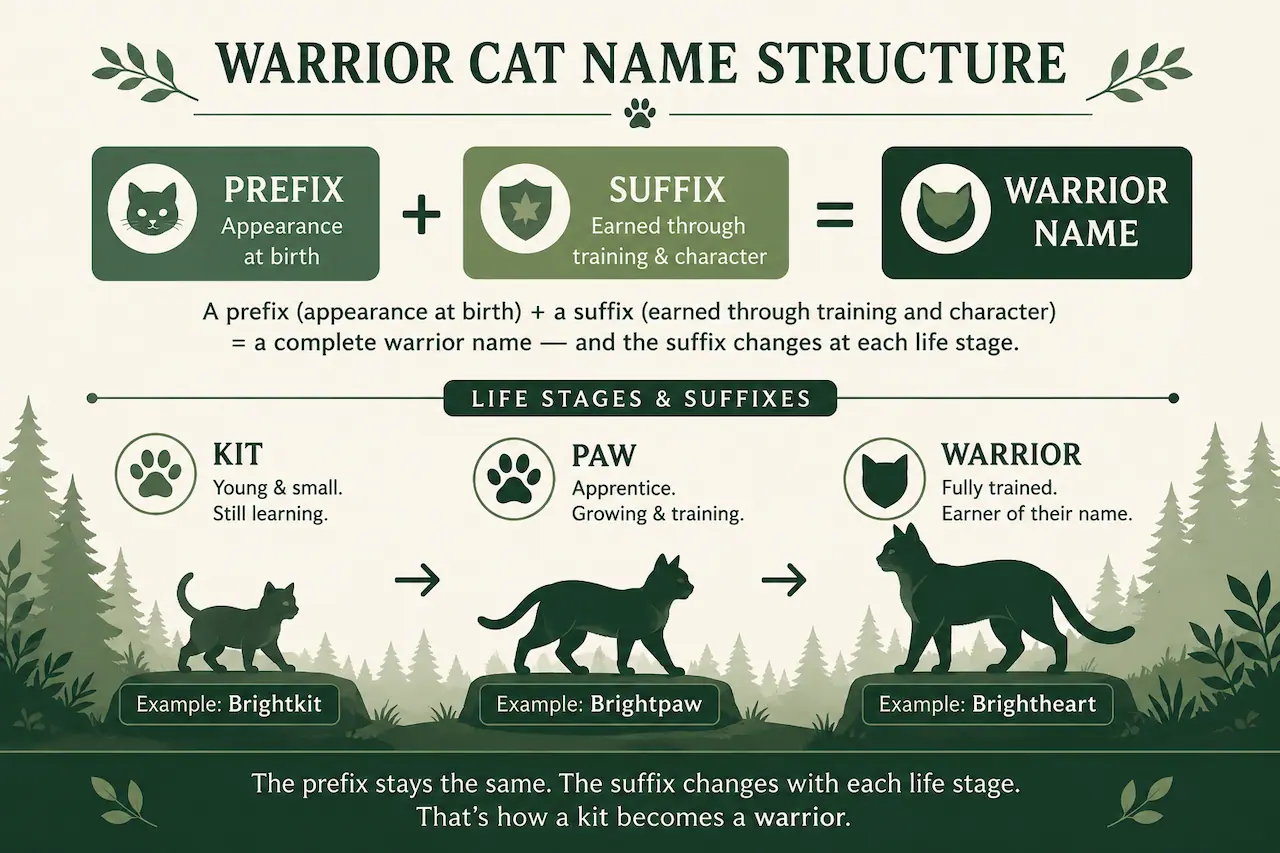
Warrior cat name structure: a prefix (appearance at birth) plus a suffix (earned through training and character) equals a complete warrior name, and the suffix changes at each life stage.
How Warrior Cat Names Actually Work
Before we get into the whole prefix vs suffix thing, a quick refresher on how the naming system is set up, because it is more intentional than most people realize.
Every cat in the Warriors series has a name made of two parts: a prefix and a suffix. The prefix describes physical appearance, personality traits, or elements from nature, while the suffix changes based on the cat's life stage and often reflects their skills or characteristics.
And the life stages? They go like this:
Kits are born with a nature-inspired prefix and a “-kit” suffix. At six moons, the suffix changes to “-paw” when they begin training as apprentices. After passing their warrior assessment, they receive a new suffix from their leader that reflects their personality or skills. When a deputy becomes leader and receives nine lives from StarClan, they get the suffix “-star.”
So the name is not static. It evolves with the cat. That alone tells you a lot about which half carries more weight and we are about to get into exactly that.
Prefixes: All About Appearance
Here is the thing about prefixes. They are not chosen by the cat. They are not earned. A kit cannot walk up to its mother on the day it is born and negotiate its name. The prefix is given at birth, usually by the mother, based almost entirely on what the kit looks like in that moment.
Prefixes are the foundation of a warrior's name, typically chosen at birth based on the kit's appearance or circumstances.
The warrior cat name prefix should be immediate, visual, and based on what could be observed at birth.
So if a kit is born with flame-colored fur, it gets “Fire.” If it has gray stripes down its back, it gets “Gray.” If it looks like a small cloud puff, it probably ends up with “Cloud.” Simple as that.
Common Appearance Prefixes and What They Signal
Some well-known appearance-based prefixes pull straight from color, pattern, or the animal a cat resembles:
| Prefix | What It Signals | Example |
|---|---|---|
| Fire | Bright orange or reddish fur | Firestar |
| Gray | Gray coat | Graystripe |
| Tawny | Golden-brown, like a tawny owl | Tawnypelt |
| Cloud | Fluffy, light-colored fur | Cloudtail |
| Leopard | Spotted coat, often large in build | Leopardstar |
| Crow | Very dark, nearly black fur | Crowfeather |
| Dust | Dusty brown or muted gray-brown | Dustpelt |
Firestar and Cloudtail were named after their fur appearance and length. Tawnypelt could have been named after a tawny owl or just her fur color. Leopardstar, Badgerfang, and Crowfeather were named after animals they look like.
So prefixes are essentially a first impression frozen in time. The cat had no say. It just showed up looking a certain way, and the name stuck. Honest, in a way. Also a little brutal if you were born looking like “Mud.”
Why Appearance Comes First
It makes practical sense in the warrior cat world. When a kit is born, it is up to its parents, usually the mother, to give it its prefix. At that point, a kit has no track record, no battles fought, no skills demonstrated. The only thing anyone can judge is what they see. So appearance becomes the anchor — the part of the name that stays consistent as everything else in the cat's life changes.
The prefix is the “who you were born as.” The suffix is “who you became.” That distinction matters a lot once you get into suffix territory.
Suffixes: Achievement, Personality, and Everything Earned
This is where warrior cat names get genuinely interesting. When a cat finishes its apprenticeship and becomes a warrior, the leader gives it a suffix. And unlike the prefix, this one is not based on what the cat looks like. It is based on what the cat has shown the Clan.
Suffixes complete the warrior's name and often reflect their personality, skills, or physical traits. Skill suffixes should be considered first and foremost for a warrior's suffix, since it is only by grouping together in a Clan that cats can be free to specialize in specific techniques.
Think of it like a graduation title. You did not earn “heart” or “claw” by sitting around. You got it because you demonstrated something.
Warrior Cat Suffixes Meaning: What Each Category Tells You
The suffix system broadly falls into a few categories. Here is how to read them:
| Category | Suffix | Meaning | Example Name |
|---|---|---|---|
| Skill | -claw | Fierce, skilled fighter (aggressive in battle) | Lionblaze / Tigerclaw |
| -fang | Strong hunter and fighter above average | Badgerfang | |
| -flight | Agile, great at jumping and climbing | Mothflight | |
| -whisker | Intuitive, sensitive, often with hunting talent | Brackenfur (adjacent) | |
| -foot | Very fast; the sprint specialists of the Clan | Swiftfoot | |
| -wing | Good at climbing and jumping, light-footed | Robinwing | |
| Personality | -heart | Stands by own morals; outspoken and justice-minded | Fireheart |
| -storm | Unpredictable temperament; fierce and passionate | Sandstorm | |
| -stone | Steady, dependable, keeps their head in a crisis | Greystone | |
| -thorn | Witty, intelligent, a bit sharp-tongued | Berrythorn | |
| -spirit | Optimistic, spirited, upbeat | Spiresight | |
| Appearance (default) | -stripe | Distinctive stripes on the coat | Graystripe |
| -pelt / -fur | Neutral suffix for cats without standout traits | Tawnypelt | |
| -tail | Distinctive tail, or simply good balance | Cloudtail |
So the suffix is a judgment. The leader looks at the apprentice and asks: What is the most defining thing about this cat? And the answer becomes the second half of the name.
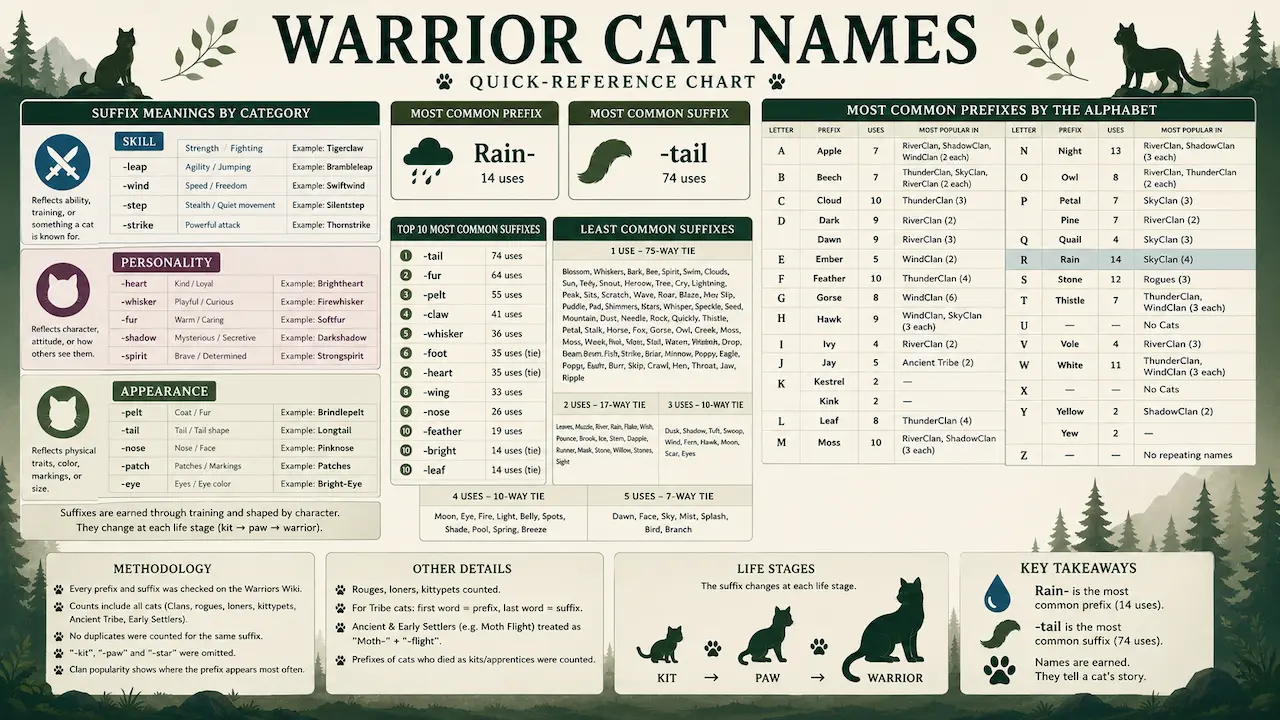
Quick-reference chart of warrior cat suffix meanings by category like skill, personality, and appearance with one example name next to each.
Real Examples from the Books
Sandpaw became Sandstorm because she was a very rude, blunt cat. “Storm” represents that trait. Firepaw became Fireheart because every cat knew him as a kind and considerate cat. Goldenflower was named for her motherly aspects, being a very kind and loving cat.
That is a clean illustration of the whole system. The prefix told you what color the cat was. The suffix told you who that cat actually turned out to be.
So Which One Actually Defines the Personality?
Short answer: the suffix.
The prefix is just a starting point. You consider itas a snapshot of appearance at birth. It has nothing to do with who the cat becomes. A cat named “Ash” could grow up to be the fiercest fighter in the Clan or the most gentle medicine cat. The prefix does not tell you.
But the suffix? A warrior has a different suffix entirely, sometimes having to do with their description, personality, or even a significance to another character. There have also been times when a character has earned their name based on an accomplishment, a discovery of great importance, or their actions in battle.
The suffix is the part that is actively given based on observed behavior. It is the leader's read on the warrior after moons of watching them train, fight, hunt, and interact with Clanmates. That makes it the more personal, and more personality-defining, half of the name.
That said, the prefix still matters. It grounds the name in something real and visible. The combination of both parts is what makes a warrior name feel complete. A name like “Fireheart” works because “Fire” already carries warmth and intensity as a visual image, and “heart” confirms that this cat's defining quality is his loyalty and care for others. Neither half alone tells the full story.
If you want to use our warrior cat name generator to create your own lore-accurate name, the generator actually handles this layered logic for you as it pairs appearance-based prefixes with personality and skill-based suffixes the way the books do.
The Special Case of -Star
No discussion of warrior cat suffixes meaning is complete without talking about the most prestigious suffix of all.
Leaders of clans have the suffix “-star.” When a deputy is accepted by StarClan as the new leader, they receive the “-star” suffix. This represents their high rank and connection to their ancestors.
“-star” is the ONLY suffix bestowed by StarClan, not chosen by living cats.
And once a cat becomes a leader, their old warrior suffix is gone. Firestar was once Fireheart. Bluestar was once Bluefur. The new suffix does not just rename them; it redefines their identity in the Clan entirely.
Earned Name Changes and Lore Exceptions
Most cats get their warrior name at the end of apprenticeship and keep it for life. But the books have a handful of cases where names change mid-life, and those cases are fascinating.
Rarely, a cat will change its name if their parents or it itself do not think it suits it anymore. There have also been times when a character has earned their name based on an accomplishment, a discovery of great importance, or their actions in battle.
One of the more memorable examples from the lore: Maggottail. He chose his name to be Maggottail because his tail was infected by maggots, and he survived. In honor of surviving it, he asked for his name to be Maggottail. Dark name. Strong statement. Absolutely lore-accurate.
Then there are cats whose suffixes were given in tribute to others. Brambleclaw was given his suffix because of Tigerstar. Violetshine was named after Puddleshine. Rootspring and Needleclaw were given the same suffixes as their mentors, Dewspring and Reedclaw.
So the suffix is not always purely about the cat's own personality. Sometimes it carries the weight of relationships, mentors, or history. Which makes it even richer as a naming element.
The Warriors Wiki actually maintains a full running list of every canon prefix and suffix used across the books, worth bookmarking if you are deep into the lore. The most common prefix is White- at 14 known instances and the most common suffix is -tail at 79 known instances. Tail is practically the default finishing touch for a generation of Clan cats, apparently.
For a deeper dive into how the official Erin Hunter team thinks about naming conventions, the Warriors Wiki naming page is a solid resource.
How to Use This When Naming Your OC
Alright, practical time. If you are building a character whether for fanfiction, roleplay, or just for fun — here is the framework:
Step one: Pick the prefix based on appearance.
What does your cat look like? Fur color, pattern, eye color, body shape, any distinguishing marks? Pick a prefix that reflects the most obvious, visible thing. Keep it simple. If you would not notice it the first time you met the cat, it probably should not be the prefix.
Step two: Pick the suffix based on personality or skill.
What is your cat known for? Not what they look like but what they do, how they act, what they are best at. Brave and aggressive? Try -claw or -fang. Loyal and moral? -heart fits well. Calm and steady? -stone or -pool. If your cat is still young or undeveloped, it is fine to default to an appearance suffix (like -stripe or -pelt) and let the character grow into something more.
Step three: Check if they clash weirdly.
“Snowstorm” works fine — gentle visual paired with an intense personality. “Sunheart” works great too. But something like “Flamepetal” might feel off unless the cat has both a fiery appearance and strong motherly instincts, which is a very specific combination. Contrasting pairs can be intentional and interesting. Just make sure the contrast is a choice, not an accident.
Conclusion
The prefix vs suffix debate has a pretty clear answer once you look at how the system actually works. Prefixes describe what a cat is born looking like — appearance, pure and simple. Suffixes describe what a cat becomes: their skills, their personality, their achievements, their legacy in the Clan.
If someone asked you to identify a warrior cat by personality alone, the suffix is your clue. If they asked you to pick them out of a crowd by sight, the prefix is where you look.
Both halves matter. But it is the suffix that carries the story. It is the half that gets chosen after the training is done, after the battles are fought, after the cat has had a chance to show the Clan what they are actually made of.
So next time you are wrestling with a warrior cat name then start with what your cat looks like, and then ask yourself: what have they earned?